Lighteyes
The Way of KingsLighteyes is the status assigned to people with light-colored eyes in the Vorin kingdoms, but the narrative presents it as more than a physical description. It is a social identity that organizes rank, determines access to weapons and offices, and shapes how people read one another before a word is spoken. Its apparent naturalness is repeatedly unsettled: the status can be inherited, displayed, challenged, or—most strikingly—acquired when a darkeyed person wins a Shardblade.
Definition and Social Meaning
Lighteyes function as the upper side of a social hierarchy divided between lighteyes and darkeyes. In the town where the young Kaladin grows up, his family are the only people of the second nahn, while most of the inhabitants belong to the fourth or fifth. That difference makes others uncomfortable around him, leaving him distinctly out of place even before his choices separate him further from them. Rank therefore operates through both formal classification and everyday behavior: people know where others stand, and they adjust their ease, expectations, and respect accordingly.
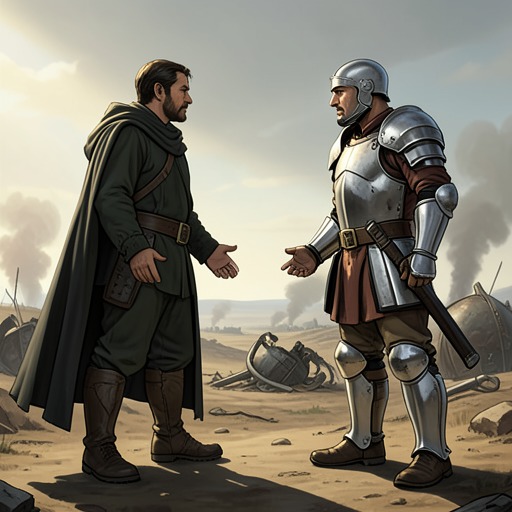
The status is also linked to the Vorin idea that every person has a possible route upward. The boys around Kaladin are told that if a man wins a Shardblade on the battlefield, his eyes become light. Even a slave, Laral explains, could become a lighteyes by winning one. The claim turns military glory into a mechanism of social transformation, presenting war as one of the few institutions in which common men can rise. At the same time, the extraordinary nature of the route exposes how firmly the hierarchy normally holds: the darkeyed majority may possess a theoretical chance, but the prize required to change status is rare, powerful, and won through violence.
Visible Markers and Public Performance
The narrative repeatedly emphasizes that lighteyes are recognized through visible signs. The Alethi appear to Szeth-son-son-Vallano as a grand people whose bearing contains a natural nobility even when they are drunk. Their men wear dark silk coats embroidered in silver or gold, and each seems suited to command on a battlefield. The women wear brightly colored silk dresses with the distinctive asymmetry of a longer left sleeve, while black hair is arranged in braids or piled forms decorated with gold, ornaments, and glowing gems. Clothing, grooming, posture, and illumination all help turn rank into spectacle.
Yet the description also contains a tension between admiration and judgment. Szeth-son-son-Vallano finds the Alethi beautiful and impressive, but he regards their use of Stormlight for ordinary lamps as profane. The same culture that appears noble and splendid to an outsider is therefore not presented as morally or spiritually unquestionable. Lighteyes are surrounded by signs of refinement, but those signs do not erase the possibility that their society misuses sacred powers or converts inherited distinction into public dominance.
Authority, Rank, and Restricted Weapons
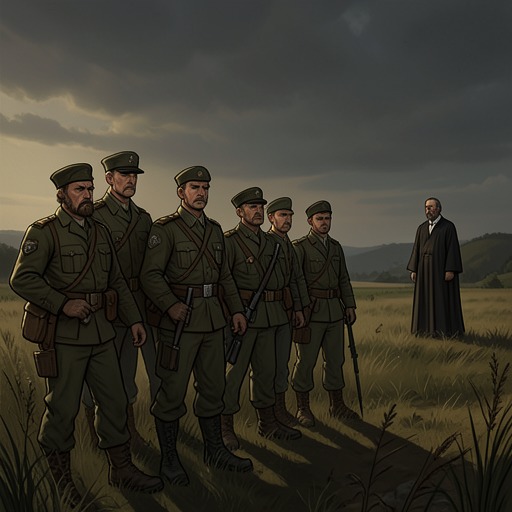
The connection between lighteyes and power becomes concrete in the royal guard at Kholinar. The guards Szeth-son-son-Vallano encounters carry spears rather than swords because they are not lighteyes and are forbidden to use the sword. Their red breastplates and helmets are ornate, and they hold honored, high-ranking positions despite being darkeyed citizens. Their office gives them dignity and authority, but it does not dissolve the weapon restriction attached to their eye color and status.
The contrast shows that darkeyes are not simply powerless or undistinguished. These guards possess rank within the limits available to them, and their ceremonial armor communicates that rank. Nevertheless, the prohibition against the sword marks a boundary that public honor cannot cross. Lighteyes therefore occupy a privileged relationship to martial power: the class is associated with the weapons, command structures, and social recognition that define Alethi warfare, while darkeyes may serve those structures without possessing equal access to them.
The distinction is especially charged when Szeth-son-son-Vallano uses a Shardblade to escape. He cuts a large square block from a stone wall, then drives it through the room by means of Stormlight and a Lashing. The Shardblade passes easily through the inanimate rock, while the effort of moving the massive block consumes so much Stormlight that frost forms on his clothing and the tempest within him dwindles to a drizzle. The scene demonstrates why access to such weapons can change a person’s place in society: a Shardblade is not merely a badge, but an instrument capable of overturning physical obstacles and political assumptions alike.
Language, Recognition, and Boundaries
Lighteyes are encountered through systems of address and service as well as through appearance. When Shallan Davar enters the Conclave, she raises her freehand in a sign of need, and a master-servant promptly approaches her and addresses her as Brightness. He speaks Veden, likely because of the color of her hair, and responds with a crisp bow and refined service. His own position is identified as that of a second-nahn darkeyed citizen of very high rank, showing how the hierarchy is reproduced through speech, gesture, language choice, and ritual deference.
The Conclave’s social world is therefore organized by more than eye color alone. Titles, nahn rank, native language, professional roles, and service customs work together to make status legible. The master-servant’s conduct is not casual politeness; it is a learned performance of a society in which a person’s place is continually acknowledged through formal interaction. Shallan Davar feels more comfortable inside the Conclave among attendants, scribes, and lesser brightlords and brightladies than she did outdoors, because the institutional setting restores the hierarchy she understands.
The surrounding evidence also shows that language itself can mark cultural boundaries. Ishikk’s companions ask him to swear by Nu Ralik, treating the name as the name of his god, while Ishikk warns them not to speak it. The exchange concerns religious difference rather than lighteyes directly, but it illustrates the same broader habit of sorting people through names, speech, titles, and forbidden words. Social identity in this world is made audible as well as visible, and misunderstanding another group’s language or sacred vocabulary can become a form of distance and control.
The Status as a Contradiction
Lighteyes are presented simultaneously as an inherited hierarchy and as a supposedly open social order. The doctrine that a slave could become a lighteyes by winning a Shardblade gives Vorin society an image of fundamental fairness: everyone is said to have a chance to rise. But the chance depends on obtaining an exceptional weapon through battlefield achievement, making the ideal of mobility inseparable from a dangerous and highly unequal institution.
That contradiction gives the status its narrative force. Light eyes appear to be a natural sign of superiority, yet the story also treats them as the consequence of a particular social and military system. Darkeyes can hold honored positions, learn skilled professions, and imagine advancement, but they remain subject to boundaries such as the prohibition against the sword. Lighteyes consequently represent both aspiration and exclusion: they are the visible promise of transformation and the everyday reminder of how rarely transformation occurs.
The status also shapes perspective. Szeth-son-son-Vallano reads the Alethi through their clothing, physical bearing, and customs, admiring their grandeur while condemning what he sees as sacrilege. Kaladin, meanwhile, encounters the hierarchy from within a community where even a relatively elevated family rank produces discomfort. The same category thus appears differently depending on who observes it: to an outsider it can look like a people’s natural nobility; to someone living beneath its privileges, it is a system that makes belonging conditional.
Narrative Significance
Lighteyes provide the social grammar through which the book connects bodies, institutions, violence, and ambition. Eye color determines how a person is classified, but the classification is reinforced by clothing, service, language, weapons, military opportunity, and assumptions about rightful authority. The status is never only ornamental. It governs who may carry a sword, who receives deference, who feels out of place, and what kind of future ordinary people are taught to imagine.
Most importantly, the Shardblade tradition makes the hierarchy unstable without making it equal. A person can cross the boundary, but only through an act powerful enough to transform both body and social identity. That possibility keeps the system rhetorically open while preserving its unequal structure in practice. Lighteyes therefore stand at the center of the book’s examination of rank: they are a visible ideal of nobility, a mechanism of exclusion, and a promise that extraordinary power can make inherited categories yield.